The Azorean night sky

Last week, I’ve been enjoying the beautiful island that is Sao Miguel. It is the largest of the Azorean archipelago, which is an autonomous region of Portugal. With a total population of 140.000, spread over an island of 65 x 16km, you can imagine that the remote island isn’t very light polluted. The first night of my stay I decided to check out what the night sky looked like at the northern shore. My first image turned out quite great:

Looking over the north atlantic with a double open cluster and M31 clearly visible

Looking north over the Atlantic Ocean with a double open cluster and M31 clearly visible

While in the picture above the Milky Way is only very faintly visible (vertically through the center), a picture of the southern sky shows our galactic center, hidden behind dark arms of dust:
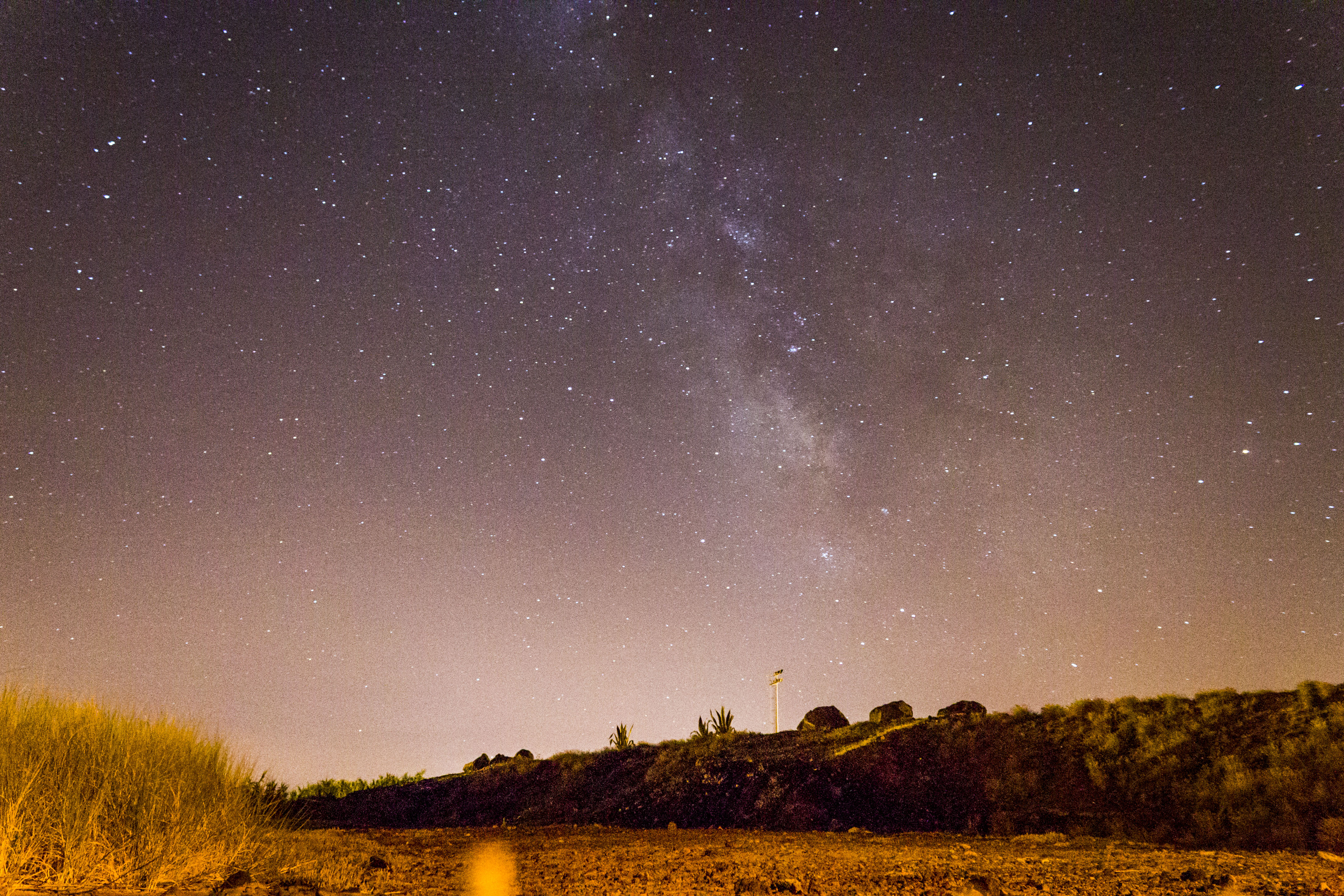
The milky way over Sao Miguel

The Milky Way over Sao Miguel

Just left of the center lies the constellation Sagittarius, in a region that isn’t visible from the Netherlands. This part of the sky contains a lot of the most beautiful deep sky objects. To show you what I mean, let me point out just the most prominent ones visible in this image:
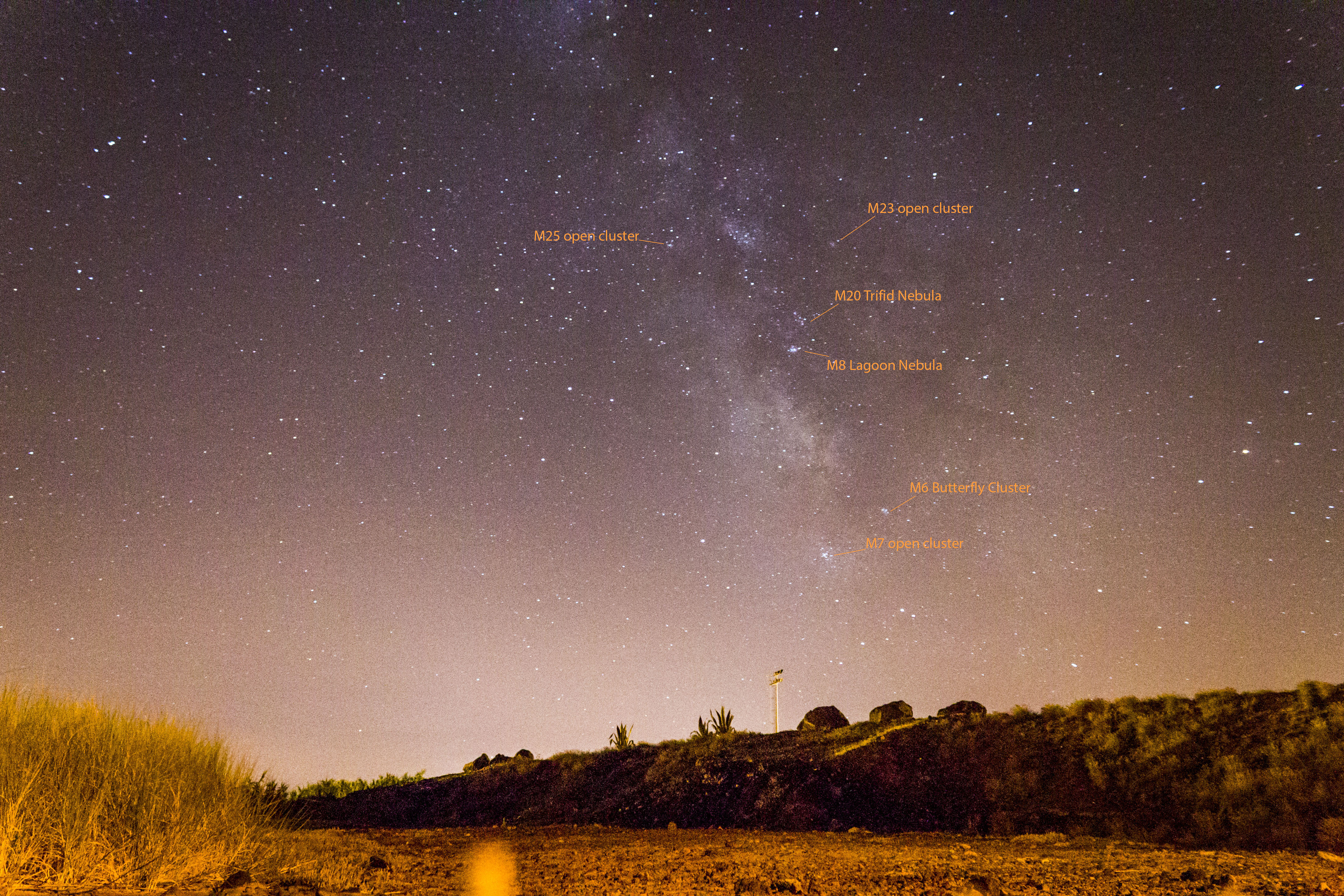
Awesome deep sky objects that I can't see from here

Awesome deep sky objects that I can’t see from here

Maybe, some day… I will be mad enough to travel south with my telescope to capture these objects, but that won’t be any time soon.

After a couple of tries (my girlfriend had to sit still for 20 seconds), I got this awesome image with M31, a double cluster, an iridium flare (satellite reflection) and a hyper active flag:
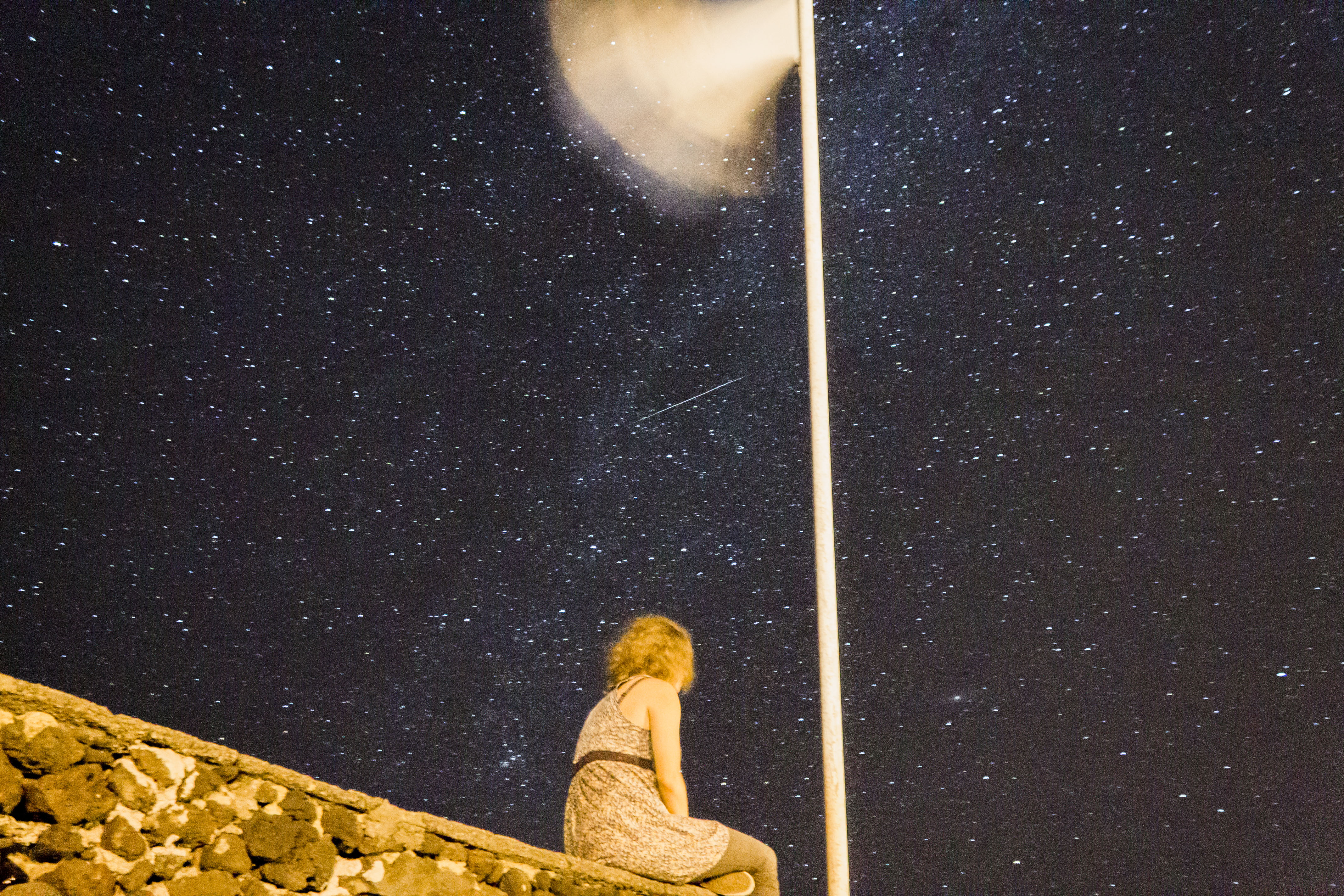
My girlfriend under the star-saturated night sky of Sao Miguel

My girlfriend under the star-saturated night sky of Sao Miguel

After that night – as you can imagine – I was quite excited about the Azorean night sky and looked forward to taking multiple exposures at 80mm (for stacking). Sadly, there were too few cloudles nights. Eventually I took my camera out one more night, but it was too windy to make proper photos at high magnification (camera movement due to wind becomes too prominent). But at 18mm focal length the photos seemed alright, so I took some final nightscape photos:

The Milky Way over Sao Miguel (glow in the center is from the city, Ponta Delgada)

The Milky Way over Sao Miguel (glow above the center hills is from the city, Ponta Delgada)
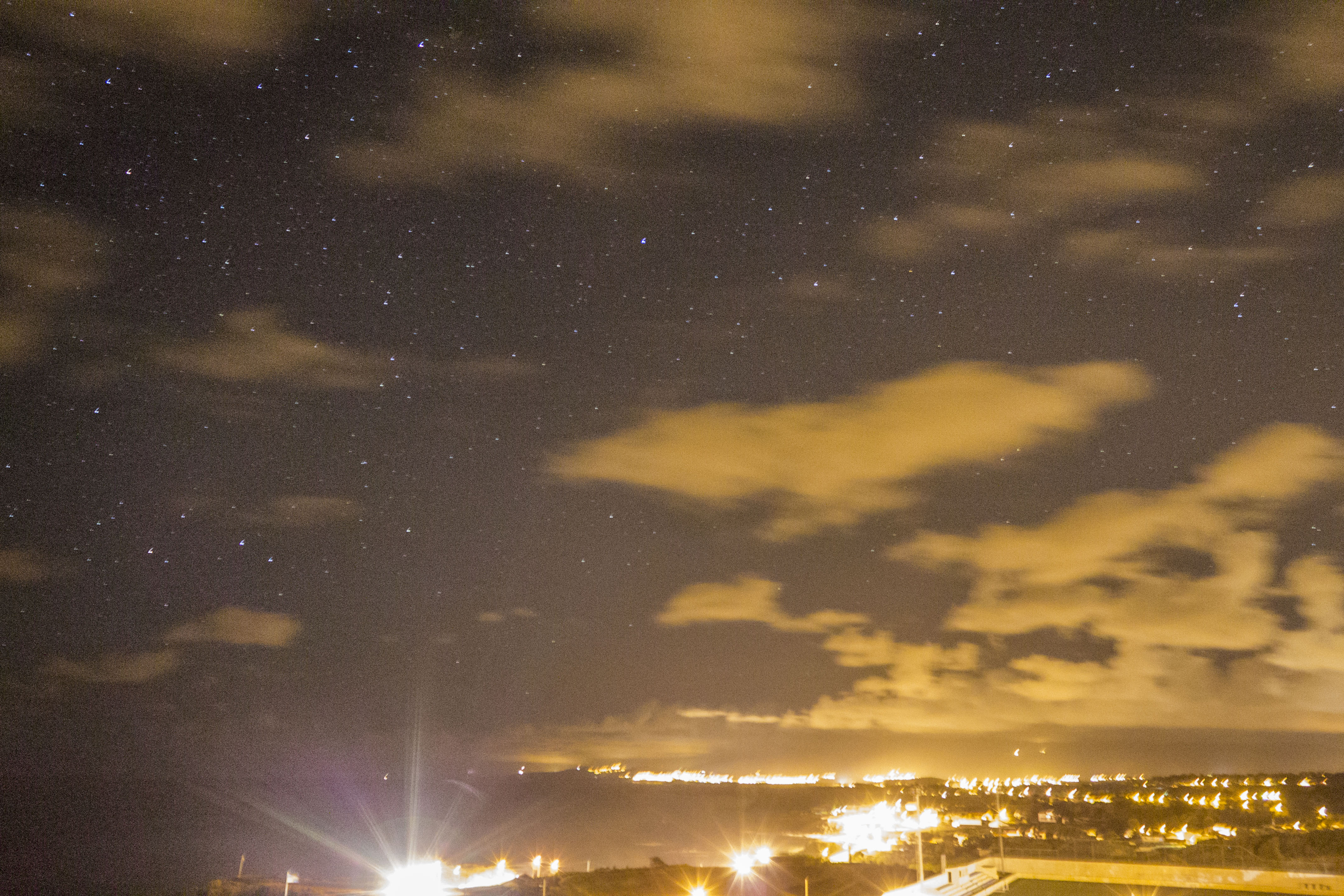
Northern shoreline of Sao Miguel at night. The bright lights in the lower left are headlights.

Northern shoreline of Sao Miguel at night. The bright lights in the lower left are headlights.

The Azorean night sky from a boat (on top of a watch tower)

The Azorean night sky from a boat (on top of a watch tower)

As you can see, clouds and wind made photography tricky (zoom in on the last image and notice that all stars are double due to camera shake). Nevertheless, the Azorean night sky was stunning at times. It’s not just at night that Sao Miguel looks beautiful, but also during daytime. Photos of that will be posted here somewhere in the next couple of days. So stay tuned!
About the Perseids meteors and the Pleiades open cluster…

As you may know, the last 2 days the Earth has been bombed by dust grains and boulders. These are remnants from the dust tail of a 26km tall comet which flies by every 130 years or so. Every year on August 12-13 the Earth travels through this dust tail which slams into our atmosphere at 58km/second, leaving behind brilliant glowing tails in the night sky. These are known as shooting stars or meteors and as many as 130 of them per hour can be seen under dark skies.

But skies aren’t that dark when the meteor shower coincides with a super Moon, as happened 2 days ago. This super Moon appears when the full Moon (which is in an elliptical orbit) is on its closest point to Earth. So aside from being at its most illuminated phase, it also appears brighter because it is as close to us as it will ever get. On a late walk 2 days ago, the Moon appeared as a small Sun, brightly illuminating the environment as though it was daytime. (Ok, not as though it was daytime, but it surely wasn’t dark…)

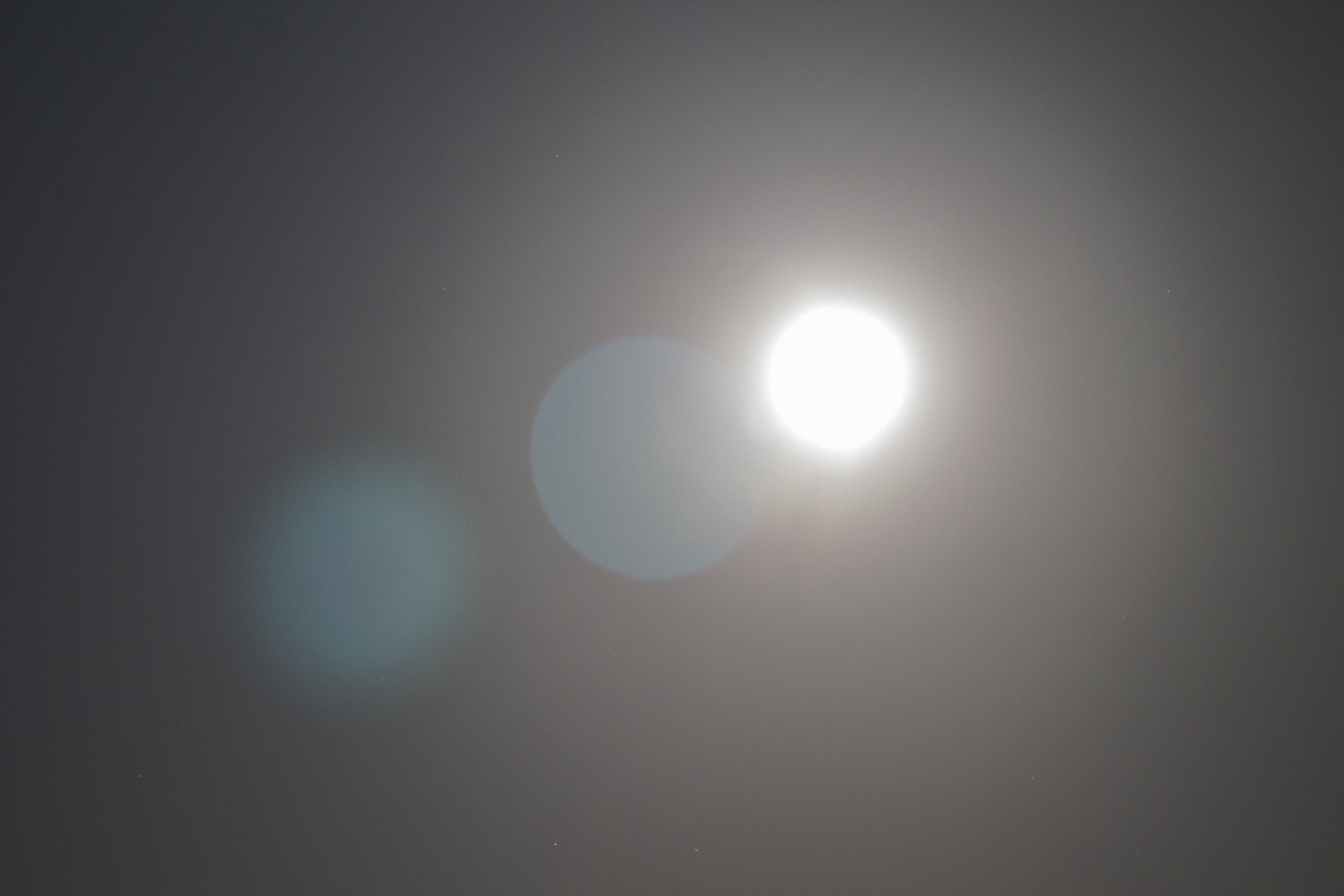
Unfortunately for us, the Moon brightened the night sky so much, that it was very hard for the meteors to stand out and the amount of visible meteors was estimated at a peak rate of 58 per hour. So compared to the 122 per hour of 2 years ago, this year’s Perseids meteor shower (yep, that’s what it’s called) wasn’t that spectacular. Below is a post processed attempt to photograph some very bright stars near the moon to illustrate the super Moon’s brightness.

Supermoon over illuminating the night sky

Super Moon over illuminating the night sky

In other news….. A few weeks ago I posted this photo of the galaxies M81 and M82:

Spiral galaxies M81 and M82 in Ursa Major

Spiral galaxies M81 and M82 in Ursa Major

In this photo, you can see that the galaxies are just too faint and small (only a few pixels big) to be properly photographed with a 80mm lens. So I imaged them through my telescope at 650mm focal length to get a well magnified view of the pair. Finding them had been difficult in the past, because they look like faint smudges through my 90mm refractor. This night however, I saw them almost instantly and took 30 0.5 second images with the DSLR on the 130mm telescope.

Galaxies M81 and M82 imaged through the telescope in 30 x 0.5 sec short exposures

Galaxies M81 and M82 imaged through the telescope in 30 x 0.5 sec short exposures

As you can see, the galaxies are quite faint and difficult to extract from the background noise. Nevertheless, in this image the galaxies are more pronounced than in the wide field image and the cigar shape of M82 is clearly visible.

Late at night, or very early in the morning, I can see the Pleiades open cluster from here. The Pleiades cluster (Messier 45) is the brightest open cluster we can see and is clearly visible to the unaided eye. This is what M45 looks like in a stacked image of 5 x 4-second exposures with an 80mm lens:

Open cluster M45 (Pleiades) imaged with 80mm lens in 5 frames of 4 seconds

Open cluster M45 (Pleiades) imaged with an 80mm lens in 5 frames of 4 seconds

And this is the same cluster imaged through my f/5 reflector telescope:

Open cluster M45 (Pleiades) through 650mm f/5 telescope

Open cluster M45 (Pleiades) through 650mm f/5 telescope

As I have no automatic guiding system yet, I had to keep the exposure time limited to 0.5 seconds and couldn’t capture the blue-ish glow faintly seen in the 80mm photo. Someday I hope to take a longer exposure of several minutes to resolve the brilliant blue reflection nebula that surrounds the stars.