Sometimes astrophoto processing can be quite time consuming. The last couple of days I spend quite some time behind my laptop to get the best results out of my raw astrophotos. First of all a Saturn photo from Tuesday the 1st of July.
I still haven’t figured out how to remotely make video recordings with my dslr attached to a telescope. Instead I shot about 120 photos, which is not a lot of frames, but I got bored of clicking the shutter button soon. The image below is the result of a 65 image stack. Whenever I find out how to make videos with the DSLR attached to a telescope, I will be able to push the enhancement sliders a lot more and hopefully to resolve some more detail. Until then, I’m very happy with my best Saturn so far:

Saturn through a 90mm reflector with fairly good seeing
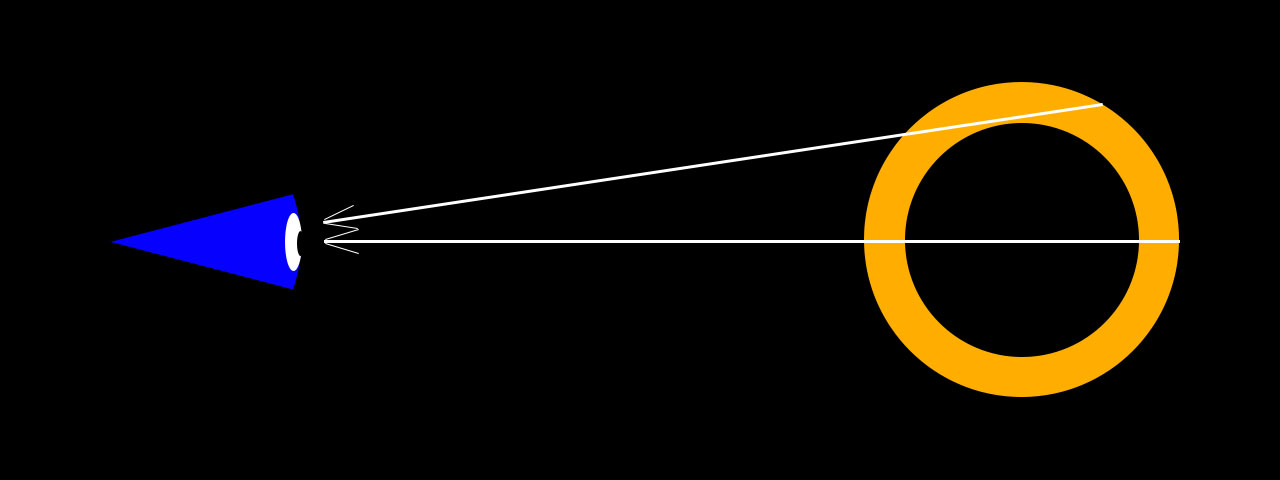
The evening of the 2nd I got my full gear out again and went searching for some cool deep sky objects. One of the easiest to find is the Ring Nebula (Messier 57). Just like the Dumbbell Nebula from earlier, this is a planetary nebula. It is an illuminated bright shell of gas enclosing the center star. Why it appears as a ring instead of a ball hopefully becomes clear from the image below:
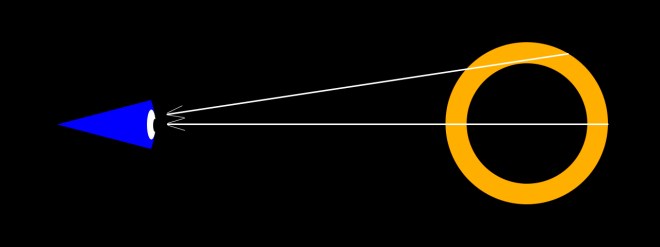
The upper line contains much more light from the nebula compared to the lower line, which only crosses through a thin layer of gas.
That said, I present to you, my first image of the Ring Nebula:

The Ring Nebula (M57) through a 130mm telescope with light pollution filter
On the upper right the double star Sheliak shows some cool diffraction spikes. A double star? Yes. The two are simply too close to be distinguishable. I will try to show you a cool double star soon.
Up next: the Andromeda galaxy (Messier 31). I promised to try and capture a good shot of the Andromeda galaxy through my telescope. Well, it turned out to be a difficult target. Someday when it is a little higher above the horizon, I will make a ton of photos and stack them to be able to resolve some detail. A stack of 32 frames just doesn’t have enough information and this is the best I could get out of it:
[I really didn’t like this picture so I tried some more. I stacked the result of the 800ms and 1300ms images together and stretched levels in nebulosity and processed further in Adobe Camera Raw. Still not perfect, but I like it a lot more (Note that this is just the core, the outer dust lanes of the galaxy are too faint to be captured in such a short exposure time) :

Bright core of the Andromeda Galaxy
I hope you don’t mind that I deleted the previous image 🙂 ]
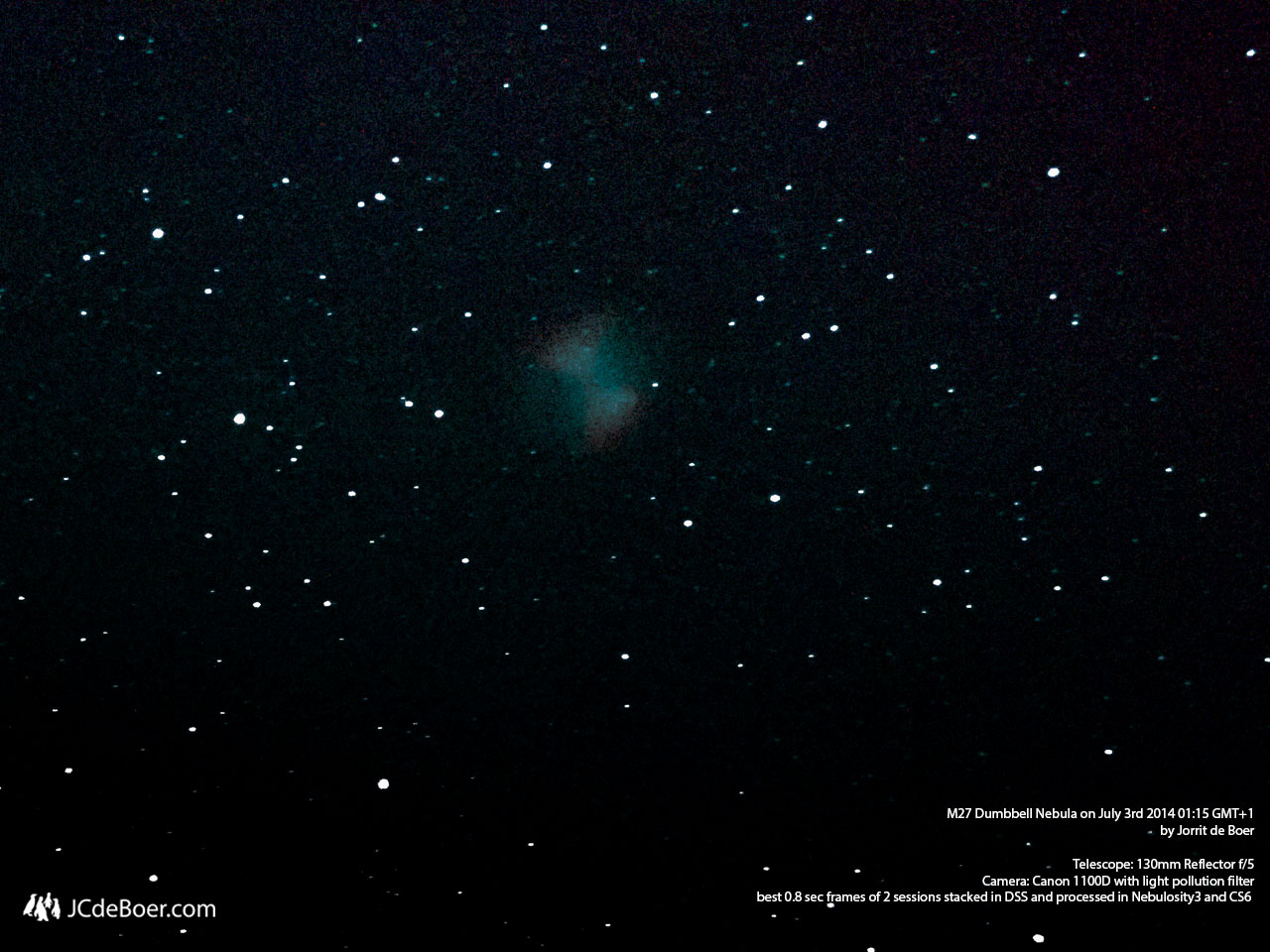
And last but not least: Another Dumbbell Nebula. This time shot through a light pollution filter. I used a very questionable adapter built from paper and duct tape to attach the light pollution filter while still being able to focus at infinity. Questionable or not, this way I avoid spending 200 euros on a dedicated filter.
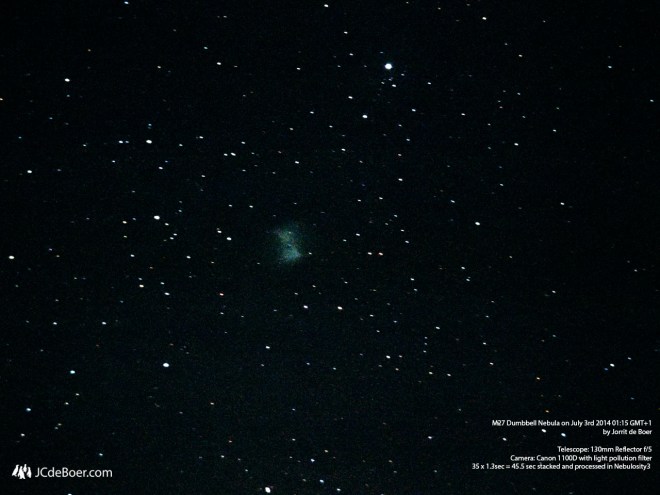
The Dumbbell Nebula (M27) through a 130mm telescope with light pollution filter
The image below is a combination of the frames from the previous session and the frames from the image above.

Best 41 frames of all the photos I got of M57 stacked together.
Also, another terrestrial photo post is coming up somewhere this week. Not as large as last time, but I definately got some cool images, so stay tuned!





 JCdeBoer.com