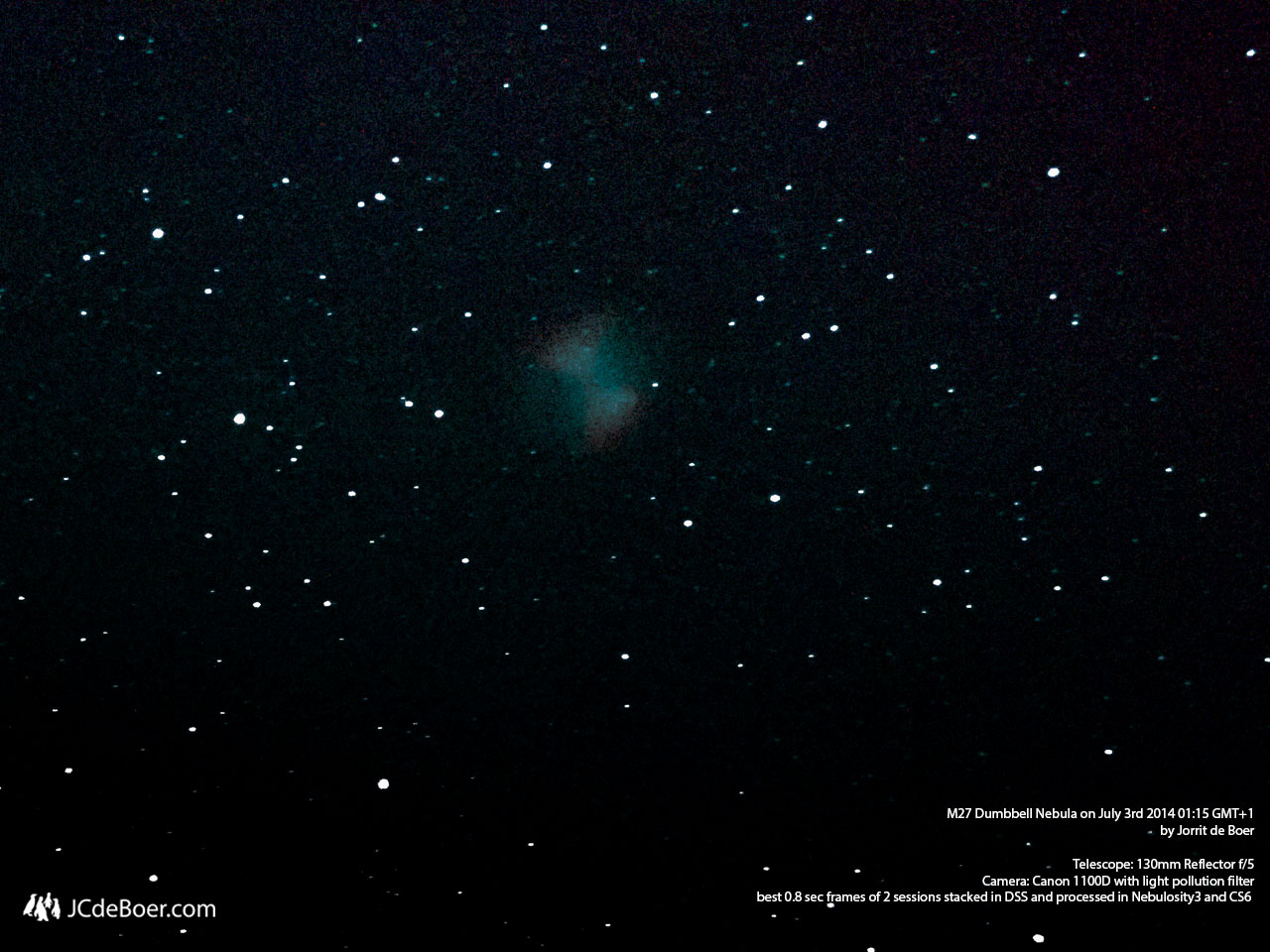
As I am quite busy with my study at the moment, I haven’t had the time to get out with my telescope. Apart from that, there also isn’t much new to show you this time of the year. You have seen what I can make of the brightest planetary nebula, star clusters and the andromeda galaxy:
-

- Best 41 frames of all the photos I got of M27 stacked together.
-

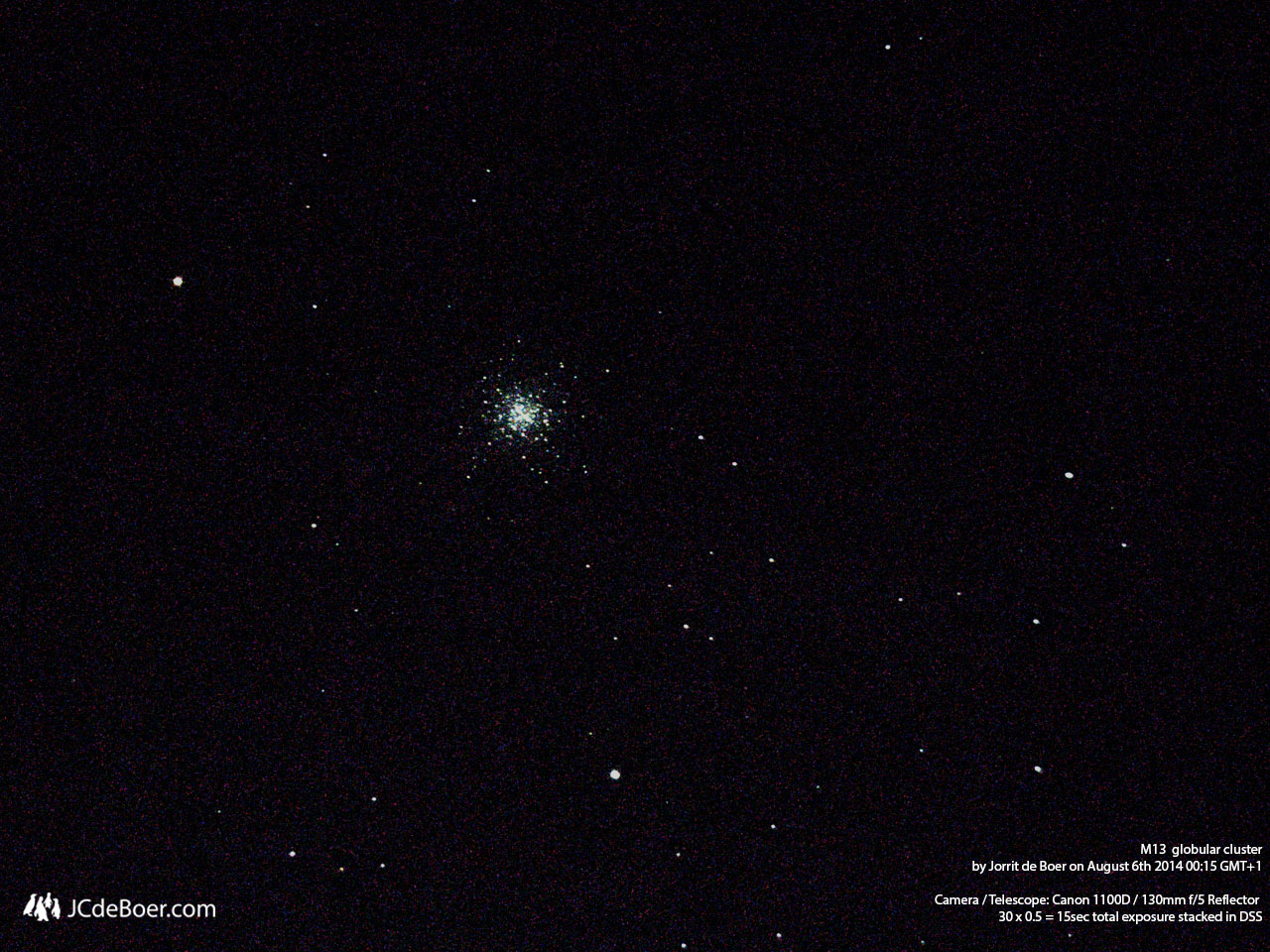
- M13 globular cluster in Hercules
-

- Bright core of the Andromeda Galaxy

There certainly is lots and lots of more interesting stuff up there, but nothing that’s bright enough for me to be able to photograph with the equipment I have right now. Once I get more time and saved me enough to buy a motorized mount, I will have so much more to show you. Until then, I will wait for Jupiter and the Orion constellation to be up at a reasonable time. I’m sure I can make some cool pictures of those with the setup I have right now.
Even though I haven’t been shooting cool pictures myself, I’ve certainly seen some taken by others that I would to share with you. Starting with this awesome image of the Dumbbell Nebula, M27 (click for supersized image):
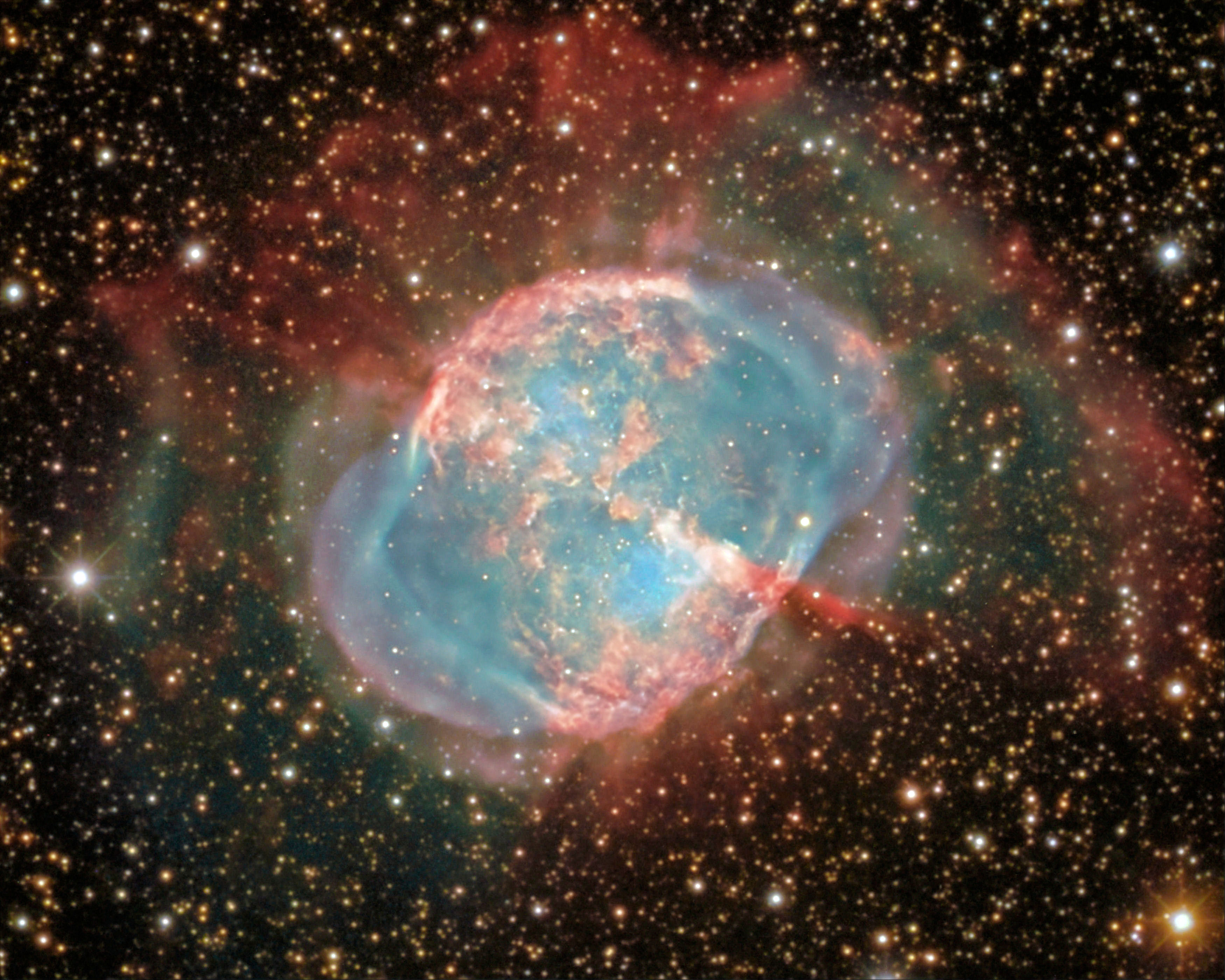
Collective image of the Dumbbell Nebula shot by 13 different amateur astronomers: Claudio Bottari, Paolo Demaria, Giuseppe Donatiello, Marco Favuzzi, Andrew Genualdi, Federico Lavarino, Rolando Ligustri (CAST), Andrea Pistocchini, Craig Prost, Christian Riou, Bert Scheuneman, Tim Stone, Rubes Turchetti (CAST)
This image is a result of 13 amateur astronomers that stacked their results (which are stacks of long exposures themselves) together into one image that contains data obtained during what must have been more than 24 hours total. You can actually see the inner star, radiating so intenste that it blows it’s outer shell away. This image is mostly green and red corresponding to Oxygen-III and H-alpha emission respectively.
On the 2nd of September, a group led by the University of Hawaii published how they discovered the structure of our supercluster. Our what? Well you know that the Earth orbits around the Sun right? And that the Sun, together with millions of other stars, orbits a supermassive black hole to form our galaxy, the Milky Way. Together with Andromeda and some 50 smaller (dwarf) galaxies we make up something called the ‘Local Group’: a small group of neigboring galaxies. This little group is in turn part of the Virgo cluster of small groups. Well, Virgo and 2 other galaxy clusters, make up our supercluster and she’s called: Laniakea, which means immeasurable heaven in Hawaiian. Her shape it shown in the image below where our Milky Way is marked with a blue dot.

Our home supercluster: Laniakea
Astronomers have indexed a huge amount of galaxies with their positions and velocities. Subtracting the velocity of the galaxies caused by the expansion of the universe, they were left with the velocities due to gravitational attraction. From their velocities (paths marked by white lines), the astronomers were able to deduce the point all galaxies in our supercluster are heading to, called ‘The Great Attractor’. Great name right?
The Northern lights have been all over the news this week and I have seen a lot of beautiful pictures coming from Canada, Alaska and Scandinavia. The best I’ve seen wasn’t photographed last week, but over a year ago. The photograph also shows a huge meteor crashing through the atmosphere and I just had to post it here.

Shannon Bileski caught this beautiful picture at March 29, 2013. You van find more of her photos at http://www.signatureexposures.com






 JCdeBoer.com